In the upcoming 139th Canton Fair, innovations in packaging will take center stage. As the demand for sustainable solutions grows, cardboard tube boxes are becoming increasingly popular. Industry expert John Smith highlights, "These boxes are not just eco-friendly; they redefine versatility."
The focus shifts to companies looking to enhance their packaging strategies. Cardboard tube boxes offer durability and are easy to customize. Their potential applications range from cosmetics to food. This adaptability can help businesses stand out in a competitive market. However, companies must also consider sourcing practices to ensure sustainability.
The introduction of AI at the Fair adds new possibilities. Attendees can efficiently find suppliers of cardboard tube boxes that meet specific standards. A well-planned search could save businesses time and resources. Yet, companies should reflect on their actual needs beyond trends. Balancing innovation with practicality is crucial in this rapidly evolving industry.

Understanding the Concept of Artificial Intelligence
Artificial Intelligence (AI) is a fascinating concept that many people are still trying to fully grasp. It involves machines that can learn and adapt. These machines mimic human intelligence in various ways. From speech recognition to decision-making, AI applications are growing rapidly. Yet, the essence of AI remains complex and often misunderstood.
Tips: Embrace curiosity. Explore AI through online courses. Engage with communities interested in technology. It’s a journey worth taking.
In reality, AI has limitations. It lacks emotional understanding. Algorithms can only analyze data sets. This can lead to bias if the data is flawed. Human insight is still crucial in many areas. The balance between AI and human judgment needs careful consideration.
Tips: Reflect on AI's impact. Consider ethical implications. Ask, “How can we use AI wisely?” This thought process is essential for responsible development.
By delving deeper, we can appreciate both the potential and hurdles of AI. We must remember that technology should serve humanity, not overshadow it. The road to understanding AI requires an open mind and constant adaptation.
Understanding the Concept of Artificial Intelligence
This bar chart illustrates the growth of artificial intelligence technologies over the past five years, showcasing the adoption rates across various sectors.
Historical Development of Artificial Intelligence Technology
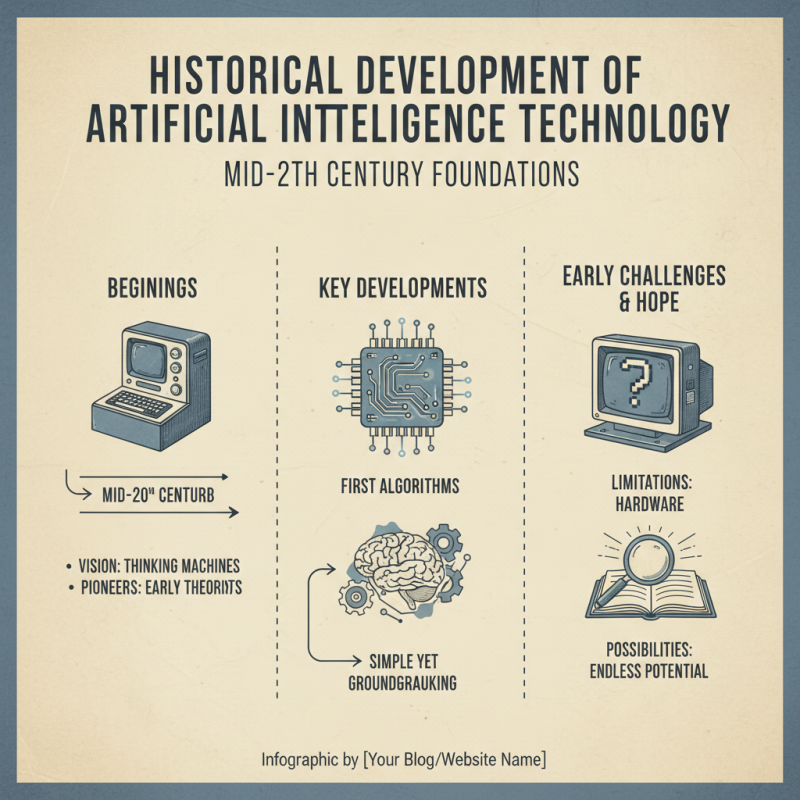
The historical development of artificial intelligence technology is a fascinating journey. It began in the mid-20th century. Early pioneers envisioned machines that could think. They created basic algorithms, which were simple yet groundbreaking. Computers were limited, but possibilities felt endless.
In the 1970s and 1980s, AI faced challenges. Ambitious projects often failed to meet expectations. Funding dried up, leading to a period known as the AI winter. However, researchers persisted, leading to gradual advancements. The introduction of machine learning changed the game. It allowed computers to learn from data and improve over time.
The 21st century marked a turning point. Data became abundant, and computing power soared. AI systems entered everyday life. Yet questions arise. Are we ready for these changes? The ethical implications of AI development require serious reflection. As technology evolves, so must our understanding of its impact.
Key Applications of Artificial Intelligence in Various Industries
Artificial intelligence (AI) is transforming industries across the globe. In healthcare, AI improves diagnostics using advanced algorithms. It can analyze medical images faster than humans. This leads to quicker treatment decisions, potentially saving lives. Yet, the reliance on AI raises ethical concerns. Data privacy is crucial, as sensitive information may be misused.
In the financial sector, AI aids in fraud detection. Algorithms sift through data to identify unusual transactions. This proactive approach protects consumers and institutions alike. However, over-reliance on automated systems can create vulnerabilities. Human oversight remains vital to prevent errors.
Retail is another prime area for AI. Personalized recommendations enhance shopping experiences. Customers receive tailored suggestions based on their preferences. Yet, this can lead to privacy issues. Users may feel uncomfortable with constant tracking. Companies must find a balance between convenience and respect for privacy.
Key Applications of Artificial Intelligence in Various Industries
| Industry |
AI Application |
Benefits |
| Healthcare |
Medical Imaging Analysis |
Enhanced diagnosis accuracy and speed |
| Finance |
Fraud Detection |
Reduced losses from fraudulent activities |
| Retail |
Personalized Recommendations |
Increased customer satisfaction and sales |
| Manufacturing |
Predictive Maintenance |
Minimized downtime and maintenance costs |
| Transportation |
Autonomous Vehicles |
Improved safety and traffic efficiency |
Ethical Considerations Surrounding Artificial Intelligence
Artificial Intelligence (AI) is reshaping industries rapidly. However, ethical considerations loom large. A recent survey reveals that 78% of executives worry about AI ethics. Issues such as bias and accountability are significant concerns. The data shows about 70% of AI models exhibit some form of bias, which can lead to unfair treatment.
Transparency in AI algorithms is critical. A report indicates that 60% of users feel uncomfortable with AI's decision-making processes. They want clarity on how decisions are made. Without this, trust diminishes. A notable example includes AI used in hiring, where biased algorithms can lead to missed opportunities for qualified candidates.
These challenges require reflection. Companies must assess their AI policies. Developing responsible AI practices is essential. Not addressing ethical issues may lead to reputational damage. The road ahead requires careful navigation. Ignoring these aspects can result in serious ramifications for society.
Future Trends and Predictions for Artificial Intelligence Development
As artificial intelligence continues to evolve, future trends are becoming clearer. The integration of
AI into daily life is growing. More homes will have smart devices
that learn user preferences. This could enhance convenience but also raises privacy concerns.
Can we trust machines with our personal data?
Job markets will also be affected by AI advancements. Many tasks will be automated, leading to job
displacement in certain sectors. However, new job opportunities can emerge in tech
and AI management. Workers will need to adapt and develop new skills.
Education systems may struggle to keep pace with these changes. Will they provide the necessary
training fast enough?
Another trend is the ethical use of AI. As algorithms become more powerful,
questions about bias and accountability will arise. Ensuring fairness in AI systems is a challenge that requires
ongoing dialogue. Addressing these concerns is essential for widespread acceptance. The path ahead promises
significant innovation but also demands careful reflection on its implications.